
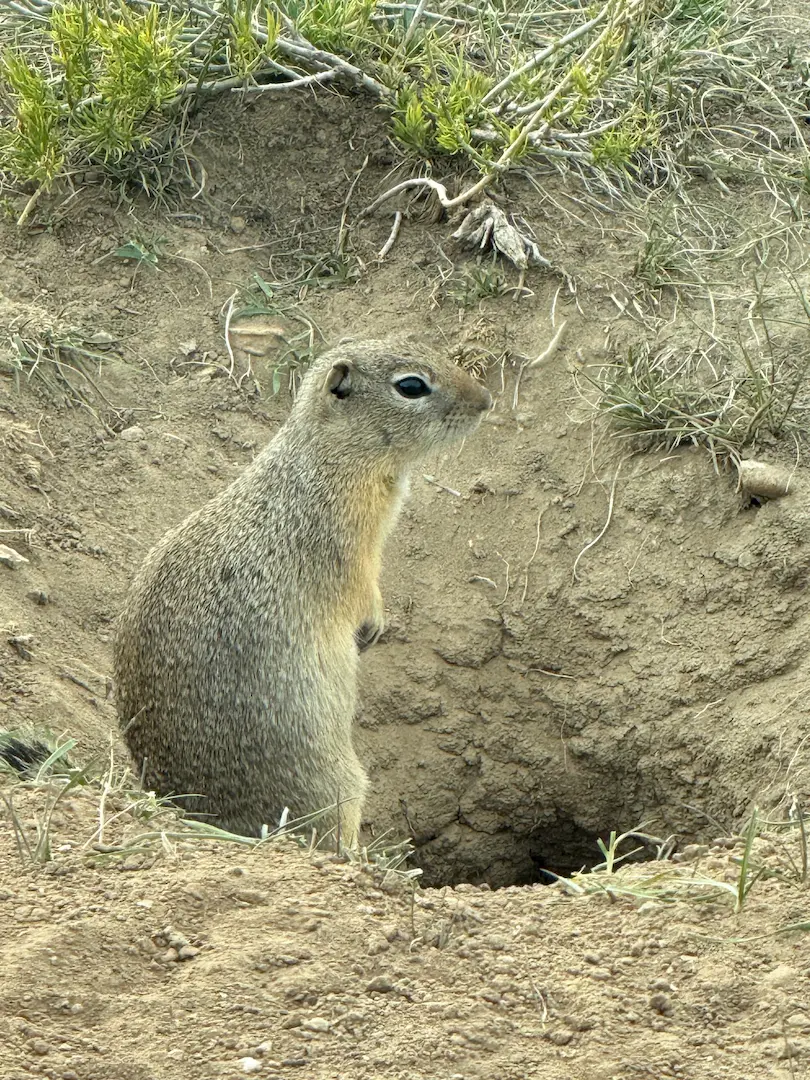
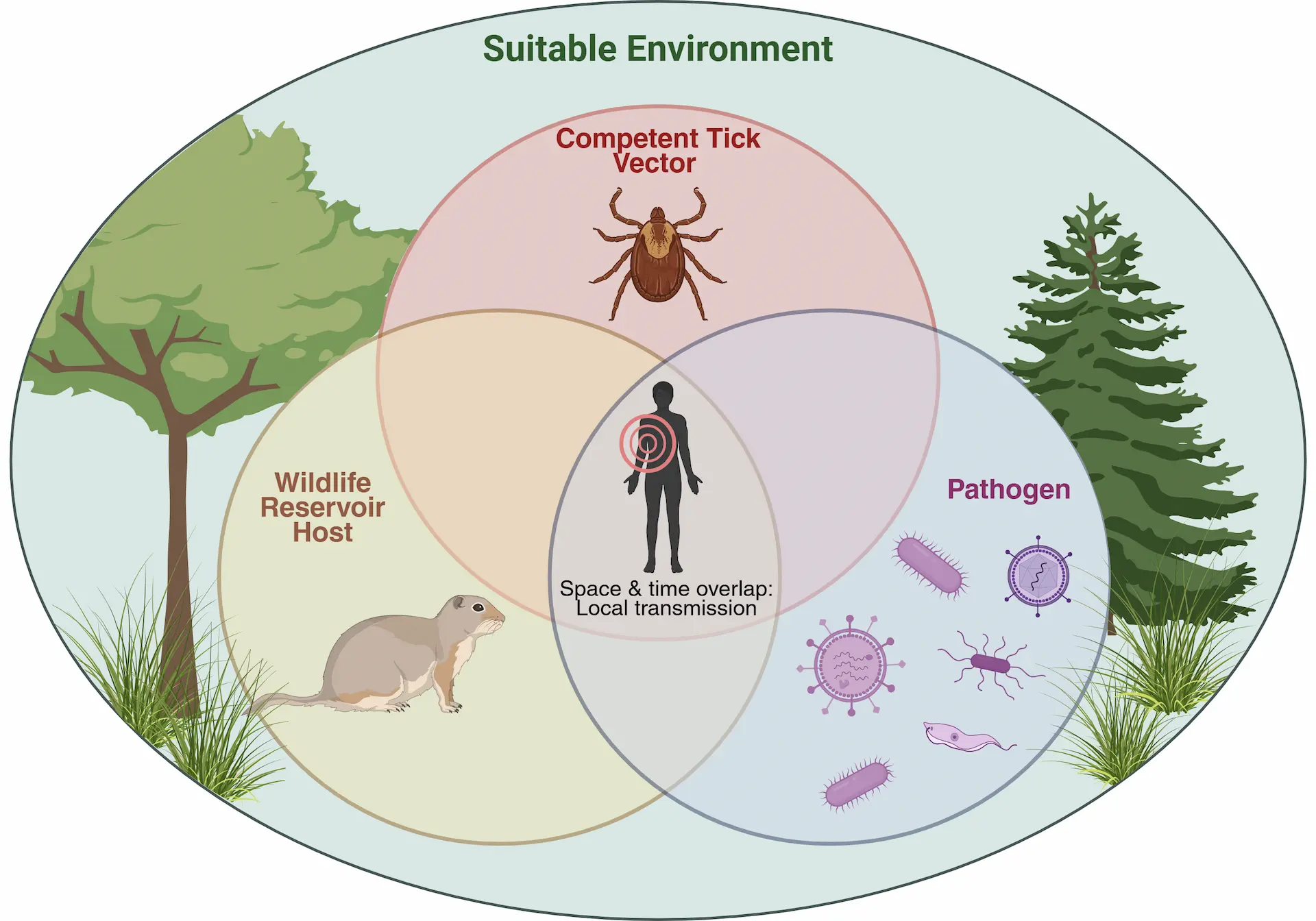
A tick-borne disease occurs when a human or animal becomes infected after being bitten by a tick carrying a pathogen (a germ), such as a virus, bacterium, or parasite. Ticks don’t usually start out infectious, however. They acquire pathogens when they feed on infected wildlife called reservoir hosts, which help maintain the pathogen in nature. If that same tick later takes another blood meal, say from a person, it may be able to transmit an acquired pathogen to them. Ticks that can both acquire and transmit a pathogen are called competent tick vectors. Importantly, not all ticks are competent vectors for all pathogens.
Many pathogens can only be transmitted by specific tick species. These species are considered to have medical or veterinary significance, while others pose little to no health risk. This is why understanding precisely which ticks live in Wyoming and what they can transmit, matters significantly for assessing locally relevant tick borne-disease risk.
Many tick-borne diseases cause similar early symptoms, such as fever, headache, fatigue, muscle aches, or rash. Anyone who becomes ill after a tick bite or potential tick exposure should contact a healthcare provider. TCWP offers tick identification services to help Wyoming residents determine which tick species they encountered.
Local Relevance Matters
For local transmission of a tick-borne pathogen to occur, the pathogen, competent tick vector, and wildlife reservoir host must overlap in space and time within a suitable environment. As a result, tick-borne diseases are often geographically specific: human exposure can only occur where the necessary components of the disease transmission cycle come together.
Ticks in Wyoming: Medical & Veterinary Significance
Wyoming is home to several tick species of medical and veterinary significance, including the Rocky Mountain wood tick (Dermacentor andersoni), the American dog tick (Dermacentor variabilis), the brown dog tick (Rhipicephalus sanguineus), and soft ticks (Ornithodoros spp.). There are also numerous wildlife ticks in Wyoming, but they pose little to no health risk to humans.
Other medically significant ticks found elsewhere in the United States, such as the tick species that transmit bacteria that cause Lyme disease, are not currently known to be established in Wyoming. Tick distributions can change over time, however, through a process called range expansion. To monitor for range expansion of vector species not currently established in Wyoming, TCWP and collaborators collect ticks throughout the state to determine which species are present, where and when they are active, and which pathogens they carry. These data allow us to describe locally relevant tick-borne disease risks.
Wyoming Tick-Borne Pathogens & Syndromes
Colorado Tick Fever
Colorado Tick Fever (CTF) is a viral tick-borne disease that occurs in the western United States and Canada. The virus is transmitted to people through the bite of an infected Rocky Mountain wood tick (Dermacentor andersoni). CTF can be an intense, febrile illness and common symptoms include:
- Fever and chills
- Headache
- Muscle and body aches
- Fatigue
- Occasionally, vomiting, abdominal pain, or rash
- Biphasic fever
Approximately half of patients experience a biphasic fever: several days of symptoms, followed by a period of improvement and then a second, usually shorter period of illness. Most people recover completely, although fatigue and weakness may persist for several weeks. Colorado tick fever can occasionally affect the central nervous system, but severe complications are rare. There is no medication that specifically treats the virus, so treatment generally focuses on relieving symptoms and monitoring for complications.
Visit the CDC’s Colorado Tick Fever website to learn more.
Rocky Mountain Spotted Fever
Rocky Mountain Spotted Fever (RMSF) and other spotted fever rickettsioses are a group of tick-borne diseases caused by related bacteria belonging to the spotted fever group Rickettsia. RMSF, caused by Rickettsia rickettsii, is the most severe disease in this group.
Multiple tick species can transmit Rocky Mountain spotted fever, including the Rocky Mountain wood tick (Dermacentor andersoni), American dog tick (Dermacentor variabilis), and brown dog tick (Rhipicephalus sanguineus). All three species occur in Wyoming, although the Rocky Mountain wood tick is the most abundant of the three.
Early symptoms may include:
- Fever
- Severe headache
- Muscle aches
- Nausea or vomiting
- Rash (not always)
Rocky Mountain spotted fever can result in severe illness and can be fatal without appropriate antibiotic treatment.
Visit the CDC’s website to learn more about Rocky Mountain spotted fever and other spotted fever rickettsioses.
Tularemia
Tularemia is a potentially serious disease caused by the bacterium Francisella tularensis. People can become infected through several different routes. These include:
- Bites from infected ticks or deer flies
- Direct contact with infected wildlife, particularly rabbits and rodents
- Inhalation of contaminated dust
- Consumption of contaminated water or food
The Rocky Mountain wood tick (Dermacentor andersoni) and American dog tick (Dermacentor variabilis), both of which are found in Wyoming, are capable of transmitting F. tularensis to people.
Symptoms vary depending partly on how the bacteria entered the body and may include:
- Sudden fever and chills
- Headache and fatigue
- Swollen or painful lymph nodes
- A skin ulcer near the site of infection
- Sore throat
- Cough, chest discomfort, or other respiratory symptoms
Tularemia can cause severe illness, but it can be treated with antibiotics. Prompt diagnosis is important.
Visit the CDC’s Tularemia website to learn more.
Tick Paralysis
Tick paralysis is a rare but potentially life-threatening condition caused by a toxin in the saliva of certain ticks. It is not caused by a virus, bacterium, or parasite and therefore is not an infectious disease.
In the Rocky Mountain region, tick paralysis is most commonly associated with the Rocky Mountain wood tick (Dermacentor andersoni). Other species, including the American dog tick (Dermacentor variabilis), can also cause the syndrome. Both tick species occur in Wyoming.
Tick paralysis occurs only while the tick remains attached and releases the toxin through its saliva into the bite site. Symptoms generally begin in the legs and may include:
- Weakness
- Unsteadiness or difficulty walking
- Loss of coordination
- Ascending paralysis that progresses towards the torso and arms
In severe cases, paralysis can affect the muscles needed for breathing and become life-threatening.
Tick paralysis is a medical emergency and children are particularly susceptible. A person who develops unexplained weakness, loss of coordination, or paralysis should receive immediate medical care and be thoroughly checked for attached ticks, particularly on the scalp and behind the ears. Most reported cases of tick paralysis occur in young children, particularly girls. Ticks attached to the scalp can go undetected beneath long hair, allowing them to feed long enough to cause symptoms.
Symptoms usually improve rapidly after the attached tick is removed, often within 24 hours.
Tick-Borne Pathogens & Syndromes of Concern Outside of Wyoming
Numerous tick-borne diseases and other tick-associated conditions occur in the United States, many of which are not currently known to occur in Wyoming. Examples include:
- Lyme disease
- Alpha-gal syndrome
- Babesiosis
- Ehrlichiosis
- Bourbon virus disease
- Heartland virus disease
- Powassan virus disease
- Hard and soft tick relapsing fevers
The ticks, pathogens, and environmental conditions associated with these diseases vary considerably across the United States. A disease that is common or emerging in one region may have little or no risk of being locally acquired in another.
Of these conditions, the two we are most frequently asked about are Lyme disease and alpha-gal syndrome. Neither is currently known to be locally acquired in Wyoming. However, because Wyoming residents may travel to areas where these conditions occur they are still important to understand.
Lyme Disease
Lyme disease is caused primarily by the bacterium Borrelia burgdorferi, and less commonly Borrelia mayonii. Lyme bacteria are transmitted through the bite of infected blacklegged ticks (Ixodes scapularis) in the Eastern and upper Midwestern United States and western blacklegged ticks (Ixodes pacificus) along the Pacific Coast. Blacklegged ticks do not occur in Wyoming. None of the ticks species that occur in Wyoming are competent vectors for Lyme bacteria.
A small number of Lyme cases are reported every year in Wyoming because when a Wyoming resident travels to another state and contracts Lyme disease, the case is reported in the resident’s home state.
What Are the Symptoms of Lyme Disease?
Early symptoms may include fever, chills, headache, fatigue, muscle and joint aches, swollen lymph nodes, and an expanding skin rash called erythema migrans. The rash may develop a characteristic "bull's-eye" appearance, but it does not always look this way.
If untreated, the infection may spread and cause symptoms involving the joints, nervous system, or heart.
Visit the CDC’s Lyme Disease website to learn more.
What About Lyme Disease in Wyoming?
Recall from the “Local Relevance Matters” section above that in order for a disease to occur locally, the pathogen, the competent tick vector species, and a suitable wildlife reservoir host all must occur in the same place and at the same time in a suitable environment. In Wyoming, an essential piece of the Lyme disease transmission cycle is missing: the competent tick vector.
The two blacklegged tick species, Ixodes scapularis and Ixodes pacificus, are the only competent tick vectors responsible for transmitting Lyme-causing bacteria in the U.S., and neither species is established in Wyoming. As such, locally acquired Lyme disease is not considered a tick-borne disease risk in the state. Wyoming residents can still develop Lyme disease after traveling to areas where infected blacklegged ticks occur.
Questions about an individual diagnosis or test result should be discussed with a licensed healthcare provider who follows standardized, evidence-based diagnostic guidelines. The absence of blacklegged ticks in Wyoming makes it especially important to distinguish evidence-based testing from nonstandard methods including blood smears that may produce misleading results.
CDC-recommended laboratory testing uses FDA-cleared serologic tests that detect antibodies to Lyme-causing bacteria. Although it also uses a blood sample, microscopic examination of a blood smear is not part of CDC-recommended Lyme disease testing because it cannot reliably establish a Lyme disease diagnosis.
More information is available in the CDC’s Lyme disease testing and diagnosis guidance website.
Alpha-Gal Syndrome
Alpha-gal syndrome (AGS) is an allergy to alpha-gal, a sugar molecule found in most mammals but not humans. People with AGS can have allergic reactions after eating mammalian meat (“red meat”), such as beef, pork, or lamb, or after exposure to other products containing alpha-gal, such as gelatin.
Unlike most food allergies, reactions may not begin until several hours after eating. Symptoms can include hives, swelling, stomach problems, difficulty breathing, or anaphylaxis, which is a severe, life-threatening allergic reaction.
What Causes Alpha-Gal Syndrome?
Unlike traditional tick-borne diseases, alpha-gal syndrome is not caused by a pathogen such as a virus, bacterium, or parasite. AGS occurs when people become allergic to the alpha-gal sugar molecule found in red meat. Tick bites are strongly linked to the development of AGS. A tick bite can cause a person's immune system to become sensitive to alpha-gal and begin producing antibodies against it, which can cause allergic reactions after eating red meat. There is a lot we still don't know about AGS, and scientists are still studying exactly how this happens.
In the United States, the lone star tick (Amblyomma americanum) has the strongest known connection to AGS. Research has found alpha-gal in the saliva and salivary glands of lone star ticks, providing potential evidence for how their bites may trigger the allergic response.
Other tick species may also be involved, including the blacklegged tick (Ixodes scapularis) and western blacklegged tick (Ix. pacificus). Numerous tick species outside the United States have also been associated with AGS.
What Does This Mean for Wyoming?
The lone star tick, the tick species responsible for most AGS cases, is not currently known to be established in Wyoming. However, suspected cases of AGS have been reported in the Mountain West, including Wyoming. This does not necessarily mean those cases were caused by tick bites in Wyoming. National AGS data are generally based on where a person lived when they were tested, not where the tick bite occurred. Some people may have been exposed while traveling.
Scientists are still working to determine which tick species can cause AGS and how tick bites trigger the allergy. Based on what is currently known about the ticks associated with AGS, the risk from tick bites occurring in Wyoming appears to be low. But as new research becomes available, our understanding of AGS and the ticks associated with it may change. A major goal of our tick surveillance program is to monitor for new tick species becoming established in Wyoming that could affect public health.
Whether Wyoming's local ticks can also cause AGS is not fully understood. The Rocky Mountain wood tick (Dermacentor andersoni), our most common human-biting tick, has not been studied in the context of AGS. Researchers have looked for alpha-gal, the sugar molecule found in red meat that people can become allergic to after tick bites, in the saliva and salivary glands of another tick species found in Wyoming, the American dog tick (D. variabilis), and did not detect alpha gal.
Visit the CDC’s Alpha-Gal Syndrome website to learn more.
Tick Bite Prevention
Ticks are a normal, native part of Wyoming’s ecosystems, particularly in grasslands and sagebrush habitats. Living and recreating in Wyoming means that tick encounters may not be avoidable. The risk of tick bites, however, can be decreased. A few simple precautions can substantially reduce your chances of being bitten while still allowing you to enjoy the outdoors.
Wear long, loose-fitting clothing when spending time in tick habitat, including long sleeves and pants. Tucking your pants into your socks and your shirt into your waistband can provide additional protection.
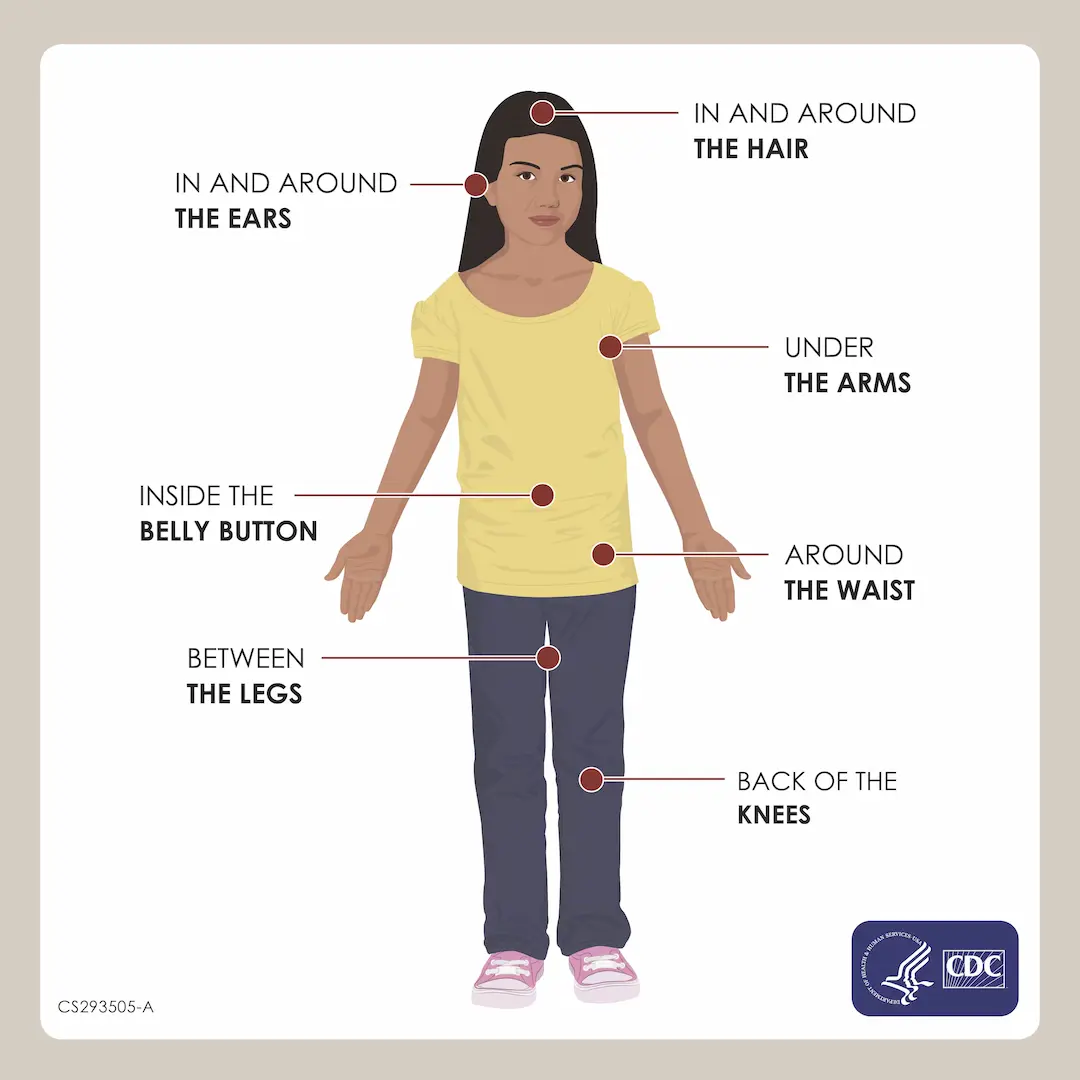
Ticks like to crawl up pant legs and under shirts. When you brush against vegetation, a tick may latch onto your clothing and crawl upward looking for a protected place to attach, such as behind the knees, around the waistband, in the groin or armpits, or on the scalp. Keeping ticks on the outside of your clothing makes them easier to spot and remove before they bite.
Know where and when to expect ticks. In Wyoming, ticks are commonly found in grassy and shrubby environments. Hibernating ticks can become active as temperatures warm and snow recedes, although activity varies with location, elevation, snow cover, and weather conditions. In many areas of Wyoming, tick activity is greatest during the spring and early summer, particularly May and June, although ticks may be encountered from early spring into fall. Visit our data dashboard to view trends in tick activity over time.
Use an EPA-registered insect repellent and reapply as directed. EPA registration matters because these products have been scientifically tested for human safety and effectiveness. EPA-registered repellents include DEET, picaridin, IR3535, 2-undecanone, oil of lemon eucalyptus (OLE), and para-menthane-diol (PMD).
Treat clothing and gear with permethrin for additional protection. Permethrin acts as both a repellent and insecticide and can be used on clothing and certain outdoor gear according to the product label. Do not apply permethrin directly to skin.
Conduct routine tick checks during and after spending time outdoors. Check your entire body, paying particular attention to areas where ticks can easily remain hidden, including:
- Behind the ears and along the hairline
- In the hair and on the scalp
- Under the arms
- Around the waistband
- In the groin
- Behind the knees
Check children, pets, clothing, and outdoor gear as well. Finding and removing a tick before it attaches is one of the simplest ways to prevent a tick bite.
Showering within two hours of coming indoors can help wash off unattached ticks and provides another opportunity for a thorough tick check. Ticks can survive through a laundry wash cycle, so tumble-dry clothes on high heat for at least 10 minutes before washing to kill any ticks on clothing.